War Glance
In early October 2025, Lebanese paramedic Haj Qassem Sultan stood outside Marjayoun Government Hospital in southern Lebanon and addressed Lebanese TV.
“Our message is clear. Even if we are killed one by one, we will not abandon our duty,” he said. “We will continue to serve Khiam and Marjayoun and Al-Taybeh and Debbine and all of our sacred land.”
He was attending a memorial for seven of his colleagues who were killed exactly one year earlier in an Israeli airstrike on ambulances parked outside the hospital. Five other paramedics, including Sultan, were wounded in the attack, in what human rights groups said was an apparent war crime.
On Friday, Sultan was killed in another Israeli strike on an Islamic Health Authority (IHA) medical center in Burj Qalaouiyah in southern Lebanon’s Bint Jbeil District. The bombing destroyed the facility, killing 12 people, including on-duty doctors, paramedics, nurses, and three patients.
The majority of the victims worked with the IHA, a healthcare and emergency service provider affiliated with Hezbollah that operates rescue and medical services in Beirut’s southern suburbs and across much of southern Lebanon and the Bekaa Valley.
Israel Killed Over a Dozen Lebanese Paramedics in Three Days, Now Claiming That Ambulances Are “Hezbollah” Targets
Will Khamenei’s Son Succeed Him? Inside Iran’s Succession Battle as Strikes Continue
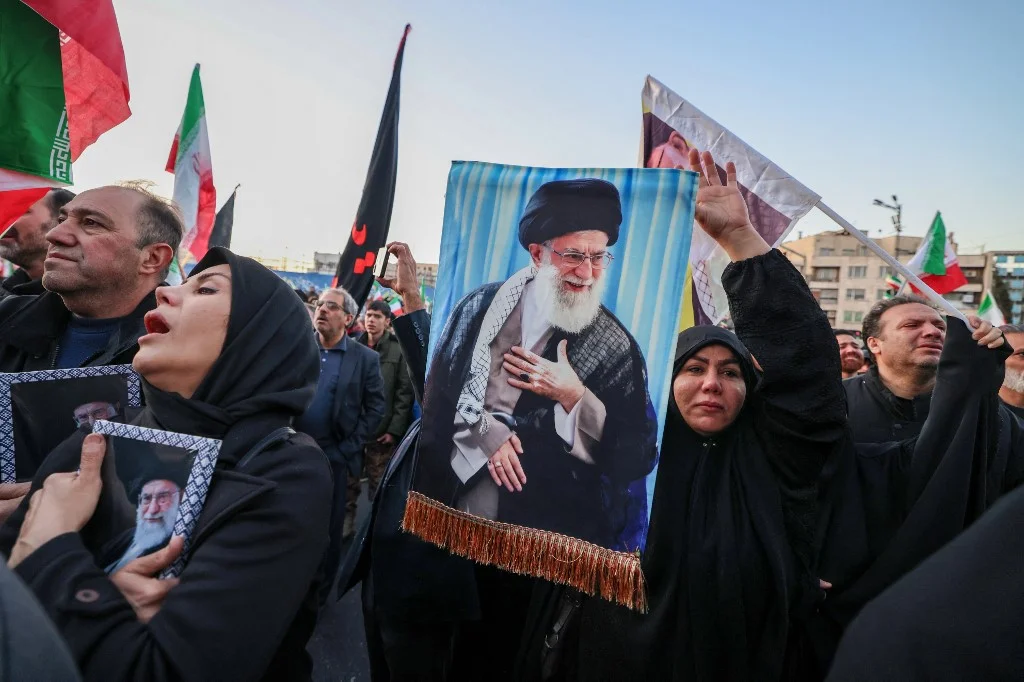 “On the US calendar it’s still March 4,” Jabbarli said, “but so much happens in a single day that sometimes it would normally take months or years.”
Ramin Jabbarli is a sociologist and the director of the Seattle-based Foundation for Inclusive Society, an NGO that regularly monitors the human rights situation in Iran. He told Kyiv Post that since airstrikes began last Saturday, it has not only been the internet – but even phone lines have been cut off.
“It’s not only about protests,” Jabbarli said. “They don’t want information to spread quickly… They want to limit communications.”
Monitoring group NetBlocks reported Iran’s connectivity falling to around 1% of ordinary levels during the blackout. Jabbarli said some footage escapes via satellite links like Starlink or through devices brought out of the country, but described those routes as limited and risky.
The most urgent political question, Jabbarli said, is what comes after Khamenei – and whether the succession stabilizes the system or becomes another trigger for conflict.
“There are different alternatives being discussed,” he said. “One is Khamenei’s son. Another is [Iran’s first supreme leader Ruhollah] Khomeini’s grandson. Hassan Rouhani is also mentioned.”
Israel warns residents in dozens of Lebanese border villages to evacuate as strikes intensify
Israel’s military issued warnings to residents of dozens of border villages in southern Lebanon to evacuate “immediately” Wednesday as airstrikes on suburbs of Beirut intensified and Hezbollah claimed more attacks.
Lebanon was dragged into the broader war in the Middle East early Monday when Hezbollah fired rockets and drones into northern Israel, triggering Israeli retaliatory airstrikes that killed more than 70 people, wounded more than 400 and displaced tens of thousands of people from southern Lebanon, the eastern Bekaa Valley and Beirut’s southern suburbs.
The ongoing conflict is not the first between Hezbollah and Israel. Hezbollah began firing into Israel a day after the Oct. 7, 2023, Hamas-led attack on southern Israel triggered the war in Gaza. After months of low-level fighting, a full-scale war erupted in September 2024 and Israel later launched a ground invasion of Lebanon.
Witnesses Describe Horror Scene After “Double-Tap” Bombing Kills Over 20 at Popular Tehran Square
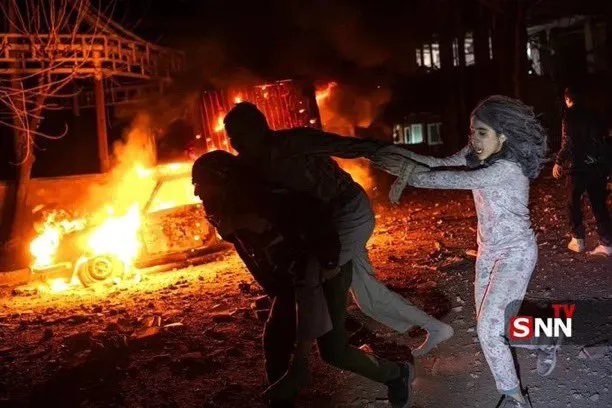 As groups of families and others gathered Sunday evening at cafes around Niloofar Square—a middle-class area in eastern Tehran—after breaking their fast for Ramadan, a series of explosions struck the area, leveling several buildings and killing over 20 people, according to witnesses at the scene and later reports from local news sources.
Witnesses who spoke to Drop Site said two explosions hit the area—a smaller strike in the vicinity, followed by a larger one that devastated much of the neighborhood, a tactic known as a “double tap” strike that is used to inflict maximum casualties.
Videos of the immediate aftermath of the attack showed several individuals dead and wounded as well as massive destruction on the street outside. In Cafe Ahla, next to the square, blood and debris soaked the floors. Several patrons who had been sitting there when the attack struck could be seen dead on the floor or with their mutilated bodies still sprawled across their seats.
“We were sitting here around 8:00-8:30 p.m. and suddenly there was the noise and explosion. We got up and a few people ran away. We turned around to get our belongings and we saw that blood was spraying everywhere. Someone’s hand had fallen on the floor, a head had fallen on the floor,” said Shahin, a witness who had been at the cafe and asked to be identified by first name only. “There were scalps torn off, hands severed, a few people were laying here all cut up and two people were martyred.”
As has been the case with nearly all of the bombings in Iran, it remains unclear whether this attack was carried out by the U.S. or Israel. Israel has used “double tap” strikes in Gaza, Lebanon, and elsewhere. In one prominent incident, the Israeli military killed 22 Palestinians, including five journalists, in a double tap strike on Nasser Hospital in Khan Younis in August. The U.S. repeatedly engaged in double tap strikes during the so-called “War on Terror” in Pakistan, Afghanistan and Yemen and, most recently, in a September 2025 attack on an alleged Venezuelan drug smuggling boat in the Caribbean.
See photos of the Pearl Harbor attack on its 84th anniversary
 The United States will mark the 84th anniversary of the Japanese attack on the U.S. naval base in Pearl Harbor, Hawaii, on Sunday, Dec. 7, as the number of Americans belonging to "the Greatest Generation" who lived through World War II diminishes.
The attack on Dec. 7, 1941, killed 2,403 service members, and civilians were killed during the attack on Pearl Harbor, according to the National Park Service. Five of the eight battleships, three destroyers, and seven other ships stationed at the base were sunk or severely damaged. More than 200 aircraft were destroyed – according to History.com.
The U.S. defeated Japan in August 1945, days after launching atomic bomb attacks on Hiroshima and Nagasaki, killing hundreds of thousands of civilians.
Here is a look at some of the photos from that fateful Sunday:
At Nuremberg, World War II’s Battle Turned to the Courtroom, and an Eloquent Lawyer Helped Lead the Allies to Victory
:focal(1285x1016:1286x1017)/https://tf-cmsv2-smithsonianmag-media.s3.amazonaws.com/filer_public/d1/4e/d14ed238-3b62-4506-9f53-fc2178dade60/nov2025_d17_prologue.jpg) In the fall of 1945, a bit more than six years after Nazi Germany invaded Poland and started the biggest and deadliest conflict in history, a largely self-taught lawyer from a tiny hamlet in the southwest corner of New York State set out to convict the surviving Nazi leadership of crimes “so malignant, and so devastating, that civilization cannot tolerate their being ignored, because it cannot survive their being repeated.”
In the fall of 1945, a bit more than six years after Nazi Germany invaded Poland and started the biggest and deadliest conflict in history, a largely self-taught lawyer from a tiny hamlet in the southwest corner of New York State set out to convict the surviving Nazi leadership of crimes “so malignant, and so devastating, that civilization cannot tolerate their being ignored, because it cannot survive their being repeated.”
In his roughly four-hour opening statement at the first Nuremberg trial, Robert H. Jackson, chief prosecutor for the United States, offered the first full public picture of how the Nazis had planned and carried out the many horrors that shock the world to this day, including the systematic murder of an estimated six million Jews.
The war in Europe had ended just six months earlier. But, as Jackson made clear to the International Military Tribunal, assembled to decide the fate of these higher-level Nazis, the Allies’ great victory would be incomplete without a legal reckoning suited to the scale of the offenses.
“The common sense of mankind demands that law shall not stop with the punishment of petty crimes by little people,” he said, as 21 defendants, including Hermann Göring, commander in chief of the Luftwaffe, and Hans Frank, who had led the Nazi terror campaign in Poland, looked on from the dock.
“It must also reach men who possess themselves of great power and make deliberate and concerted use of it to set in motion evils which leave no home in the world untouched.” The veteran litigator told the French, British, Soviet and American judges hearing the case—and the grieving world—what was to come: “We will give you undeniable proofs of incredible events.”
‘Lavender’: The AI machine directing Israel’s bombing spree in Gaza
In 2021, a book titled “The Human-Machine Team: How to Create Synergy Between Human and Artificial Intelligence That Will Revolutionize Our World” was released in English under the pen name “Brigadier General Y.S.”
In it, the author — a man who we confirmed to be the current commander of the elite Israeli intelligence unit 8200 — makes the case for designing a special machine that could rapidly process massive amounts of data to generate thousands of potential “targets” for military strikes in the heat of a war. Such technology, he writes, would resolve what he described as a “human bottleneck for both locating the new targets and decision-making to approve the targets.”
Such a machine, it turns out, actually exists.
More Articles...
- US finishes withdrawal, meeting Aug. 31 deadline after 20 years of war
- Historic peace deal in Afghanistan reached with Taliban, allowing withdrawal of US troops
- D-Day: 17 stunning photos from 1944 show how hard the Normandy invasion really was
- Syria: The End Of The 'Caliphate' Doesn't Mean The End Of ISIS
Page 5 of 118