War Glance

 In his Beirut office, Dr Ghassan Abu Sittah is going over his operating list for the weekend: 11 children in total, with life-altering injuries from Israel’s wars on Lebanon and Gaza.
“There are two siblings who have shrapnel from the 2024 war that is now causing medical problems,” the prominent British-Palestinian plastic and reconstructive surgeon told Middle East Eye.
“A boy with a partial amputation of his foot that needs reconstruction, from this war, and another boy with an amputation.”
Dr Abu Sittah hopes to finish the stump so that the patient can begin prosthetic rehabilitation.
Another boy with an elbow injury needs a prolonged reconstructive procedure to salvage his elbow joint.
‘They’re all catastrophic’: The paediatric war wounds Dr Abu Sittah tries to heal in Lebanon
Israel rejects Trump's 15-point plan for Gaza, says Netanyahu
 Israel has rejected US President Donald Trump's 15-point plan for Gaza and will not withdraw until Hamas fully disarms, Prime Minister Benjamin Netanyahu said on Sunday.
The Board of Peace, spearheaded by Trump, announced last month that it had made a breakthrough in a plan to end the war.
Israel and Hamas agreed to the plan last year, beginning with a ceasefire. Israel has continued to carry out near-daily strikes on Gaza since agreeing to the ceasefire last October.Trump said that Hamas had agreed to lay down its weapons.
“Israel rejects the 15-point document,” Netanyahu said at a cabinet meeting on Sunday.The Israeli army “will not carry out any withdrawal until Hamas is genuinely disarmed and will continue to thwart threats against our forces and our citizens”, he added.
Three Palestinians killed and dozens wounded in Israeli attacks across Gaza and West Bank
 Three Palestinians were killed in Israeli attacks on Gaza, while Israeli forces and Jewish settlers wounded dozens more across the occupied West Bank on Saturday.
In the West Bank city of Tubas, Israeli forces stormed the city with military vehicles and deployed soldiers through the centre. The Palestinian Red Crescent Society treated 15 people after troops fired tear gas at residents.
Israeli forces also raided al Mughayyir, northeast of Ramallah, and fired tear gas inside a house, leaving members of a family, including children, struggling to breathe.
Troops entered the nearby town of Turmus Ayya and the village of Abu Falah, while another Israeli force raided Kobar and fired tear gas in its streets.
Further south, Israeli settlers opened fire during an attack on Wadi al-Rakhim in Masafer Yatta, wounding four Palestinians. Medical workers took a 57-year-old man to hospital after a bullet struck his hand.
War on Iran: What is Tehran's 'shadow fleet' really and how does it work?
 Washington has reimposed its naval blockade of Iranian ports after the collapse of a planned peace deal to end the US-Israeli war on Iran.
For decades, the US has tried to isolate Iran, holder of the world’s third largest proven oil reserves, from the global shipping industry with a range of sanctions.
However, the Islamic Republic has been able to maintain some revenue through a network of rickety tankers often described as its “shadow fleet”, which occupy a legal grey zone and use subterfuge to skirt the US measures.
How do shadow fleets work?
Shadow tankers, also known as “dark fleets” or “ghost fleets”, are ships that operate on the fringes of the global shipping industry to transport oil and other commodities from countries facing western sanctions.
Many are ageing vessels that evade detection on marine traffic databases by turning off their mandatory tracking signals or broadcasting false locations.
Iran is not the only country involved in such operations: Russia, which is also subject to oil sanctions, likewise operates a shadow fleet. Venezuela did so until the US attack on the country earlier this year and the seizure of many of its tankers.
Netanyahu claims Israel protects Christians after Israeli attacks hit churches in Lebanon
 Israeli Prime Minister Benjamin Netanyahu claimed in an interview with Fox News on Sunday that Christians in Lebanon had asked Israel to “annex” their villages, many of which Israeli forces have damaged or destroyed.
Speaking on the pro-Israel US news outlet with host Jacqui Heinrich on "The Sunday Briefing", Netanyahu said “we…take care of our friends, especially the Christians in the Middle East”.
“Christian villages in Lebanon some of them have actually asked to be annexed to Israel because we protect them against Hezbollah fanatics who want to kill them and we do the same things with Christians everywhere…in the Middle East,” said Netanyahu.
But Netanyahu’s remarks sit uneasily beside Israel’s own record in Lebanon, where its forces have destroyed churches, damaged Christian religious sites and filmed soldiers desecrating Christian symbols.
Iran warns US to 'be careful' after Trump threat
 US Vice President JD Vance said on Sunday that President Donald Trump had asked him to turn over "a new leaf" in American ties with the Iranian people.
But at the same time as the talks were occurring, Trump threatened to continue bombing Iran if it did not contain Hezbollah.
Vance arrived at the Burgenstock mountain resort in Switzerland on Sunday morning to join Trump's special envoy, Steve Witkoff, and son-in-law, Jared Kushner, for technical thttps://www.middleeasteye.net/news/us-hopes-turn-over-new-leaf-iran-trump-threatens-resume-bombingalks with Iranian officials following last week's signing of a memorandum of understanding between Washington and Tehran.
"This is a historic meeting," Vance said, adding that the goal was to "turn over a new leaf to transform our relationship with the people of Iran, and to extend an outstretched hand".
"The question before us now is how much more can we accomplish together? Can we turn over a new leaf? Can we change relations in the Middle East permanently?
"Or do we go back to doing things the old way, which is not our preference, but it's certainly very much something that can happen."
In Campaign to Seize More of Gaza, Israel Expands Attacks on Palestinians Near “Yellow Line”
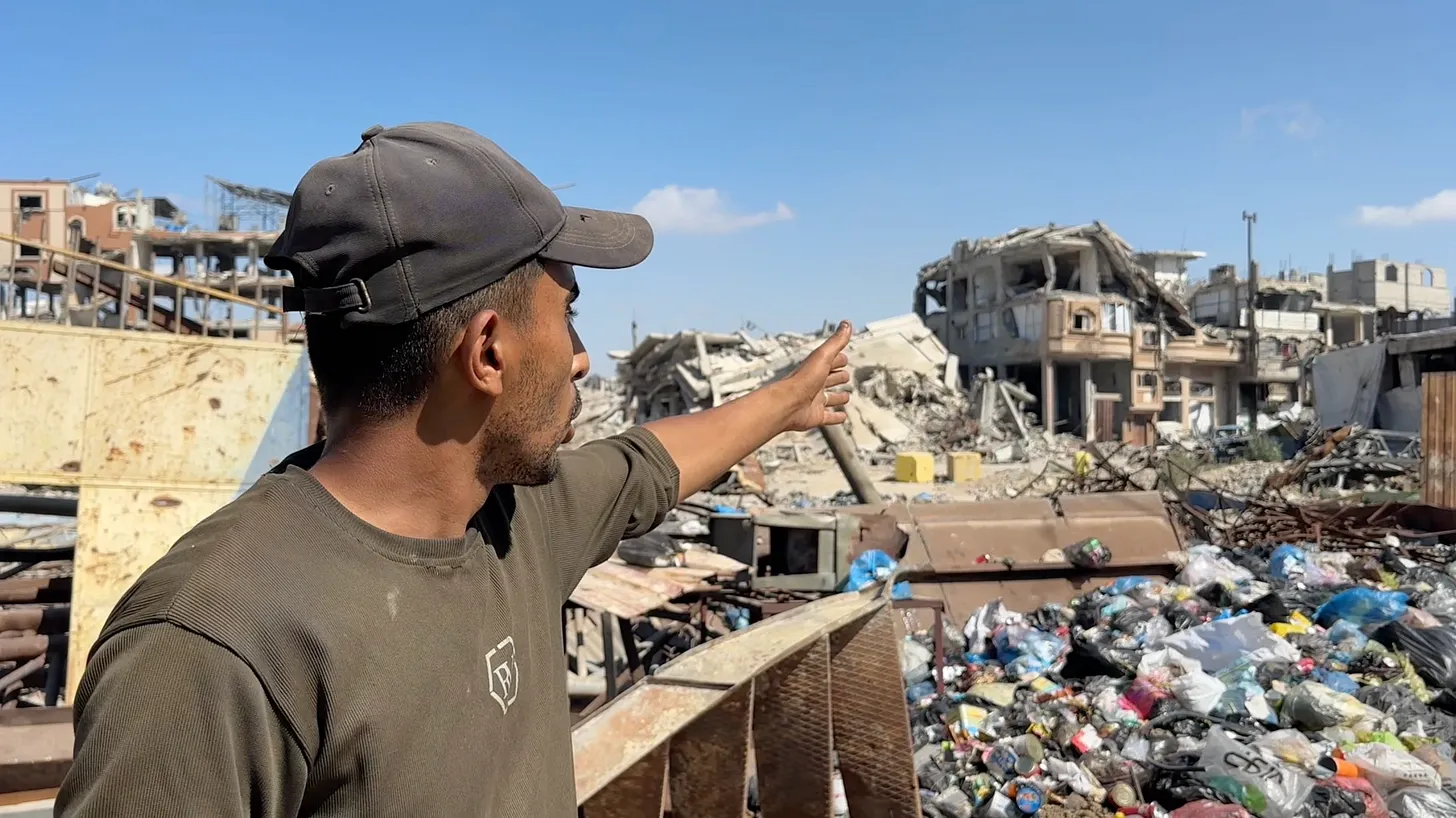 Mustafa Al-Shawa awoke at 2:30 a.m. on Monday to the sound of gunfire and the rumble of tanks in Al-Tuffah neighborhood of Gaza City. When he was finally able to go outside a few hours later, he found two yellow concrete blocks placed in the middle of the street—the Israeli military had moved them at least one hundred meters further west into Gaza where they now lay close to his home.
“They moved the yellow line forward to the Sanafour Junction. It used to be up by Al-Shaaaf Street,” Al-Shawa told Drop Site News. “This is the yellow line,” he said, pointing to the blocks. “There is another yellow line along Salah Al-Din Street that they have moved closer. Enough of what is happening to us. Enough of this suffering.”
Israel has been steadily encroaching further into Gaza, moving the “yellow line” that demarcates its area of control from 53% of the enclave since the start of the so-called ceasefire in October to well over 60%, in violation of the agreement. Prime Minister Benjamin Netanyahu recently ordered the army to take 70%.
“We can’t leave the neighborhood because there is nowhere to go,” Al-Shawa said. “If we leave the area we’re in now, we’ll end up sleeping in the streets, in filth. There is no place left. Where are we supposed to go?”
Along certain parts of Gaza, Israeli troops have placed yellow concrete blocks to delineate the new border. Their placement of the blocks further west into the Al-Tuffah neighborhood on Friday accompanied by gunfire, tanks, and quadcopter attacks caused dozens of Palestinians in the area to pack up their belongings and flee later that day.
More Articles...
Page 2 of 118