War Glance
 Tony Blair misled Parliament over advice he was given over the legality of a war against Iraq, a statement from Lord Goldsmith, the former Attorney General, suggests.
In written evidence to the Chilcot Inquiry into the war, Lord Goldsmith said statements made by the ex-prime minister in the months before the 2003 invasion that toppled Saddam Hussein were incompatible with the guidance he had given.
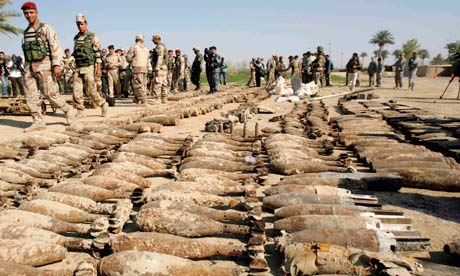 Sure enough, 15km to the south lies a big, big secret. The secret dates back to 1977, when the then-president Ahmed Hassan al-Bakr ordered the construction of a vast munitions plant outside the town. Built by the Yugoslavs, the factory was originally to be named after Bakr himself, until Saddam Hussein seized power in 1979. In a fit of patriotic zeal, the fledgling dictator named it after the Iraqi general Qa'qaa ibn Umar, who in the seventh century inflicted a most glorious massacre on the Persian army in the second battle of Qasidiya: Al Qa'qaa.
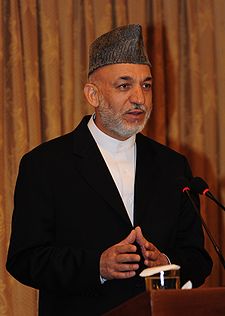 Under a new anti-corruption strategy for Afghanistan, the U.S. government won't aggressively pursue top Afghan officials suspected of malfeasance, conceding that "limited judicial capacity and political interference" from President Hamid Karzai's government make success in prosecuting them unlikely.
 After the marines arrived, a small group of Iraqis gathered around a statue of Saddam Hussein in the middle of the square and tried to bring it down with a sledgehammer and rope. More photographers and TV crews appeared. An American flag was draped over the statue’s head. Eventually, a Marine vehicle equipped with a crane toppled the statue. The spectacle was broadcast live around the world.
 In the spring of 2008, Gen. David H. Petraeus decided he had spent enough time gazing from his helicopter at an empty and desolate lake on the banks of the Tigris River. He ordered the lake refilled and turned into a water park for all of Baghdad to enjoy.
 A gentle snow fell on the funeral of Staff Sgt. David Senft at Arlington National Cemetery on Dec. 16, when his bitterly divided California family came together to say goodbye. His 5-year-old son received a flag from a grateful nation.
 Pakistani intelligence officials say three US missile attacks spaced just hours apart have killed 18 people in the country's northwest Pakistan.