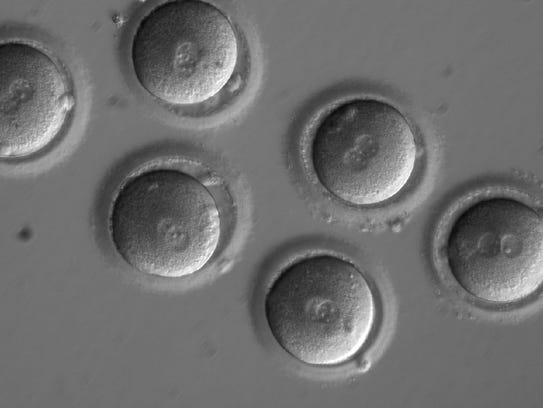
 For the first time, scientists working in a U.S. lab have used gene editing to correct a disease-causing mutation in viable human embryos, according to scientific paper published Wednesday.
The work, reported in Nature, could be a step toward genetically modified babies. But the altered embryos created in the study were quickly destroyed and never intended to be implanted in a woman — a step that would be illegal under current regulations in the United States and many other countries.
Still, the experiment moves the idea of tinkering with genes before birth “from future fantasy to the world of possibility,” said Peter Braude, an emeritus professor of obstetrics and gynecology at King’s College London.
Safety and ethical questions remain, Braude and other experts not involved in the research said. And the technique has not been perfected enough to warrant moving forward.
“We still have room to improve,” said Shoukhrat Mitalipov, a researcher at Oregon Health & Science University (OHSU), Portland and lead author of the paper.
 Down a short gravel track in a largely nondescript corner of Louisiana sits a gas processing...
 Netia McCray recalls how excited she was to join the federal advisory committee on long COVID...
 A 10,000 year-old tooth in remarkable condition from an ancient Pacific mastodon, a large mammal that...
 The universe is a strange place — filled with exploding stars, ancient galaxies, and unseen worlds....