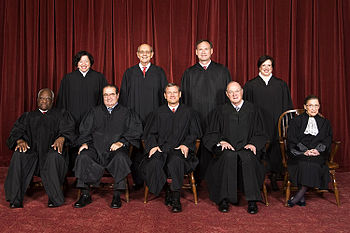
 The U.S. Supreme Court Monday, in a rare 4-4 tie, upheld laws that make it harder for an illegitimate child of U.S. father to become a U.S. citizen.
U.S. laws impose a five-year residence requirement, after the age of 14, on U.S. citizen fathers -- but not on U.S. citizen mothers -- before they may transmit citizenship to a child born out of wedlock abroad to a non-citizen.
A tie on the nine-member Supreme Court automatically affirms a lower-court ruling but sets no precedent. In the citizenship case, in which the United States was a party, Justice Elena Kagan did not participate -- having joined the court this term after serving as U.S. solicitor general.
The case involving an illegitimate Mexican son of a U.S. father was decided by a U.S. appeals court panel in California in 2008.
The son, Ruben Flores-Villar, filed suit against the laws under the equal protection component of the Fifth Amendment's due process, citing discrimination on the basis of age and gender. The suit attacked sections of the U.S. code that required a five-year residence on the part of U.S. citizen fathers, but not on U.S. mothers, before the transmission of citizenship.
 A news helicopter crashed in a Los Angeles neighborhood on Tuesday and burst into flames, killing...
 New York City officials have selected Brooklyn-based company it’s electric to expand the city's curbside electric...
 Police in Jackson, Mississippi, have arrested a man in the death of Tasia Fortune, a 29-year-old...