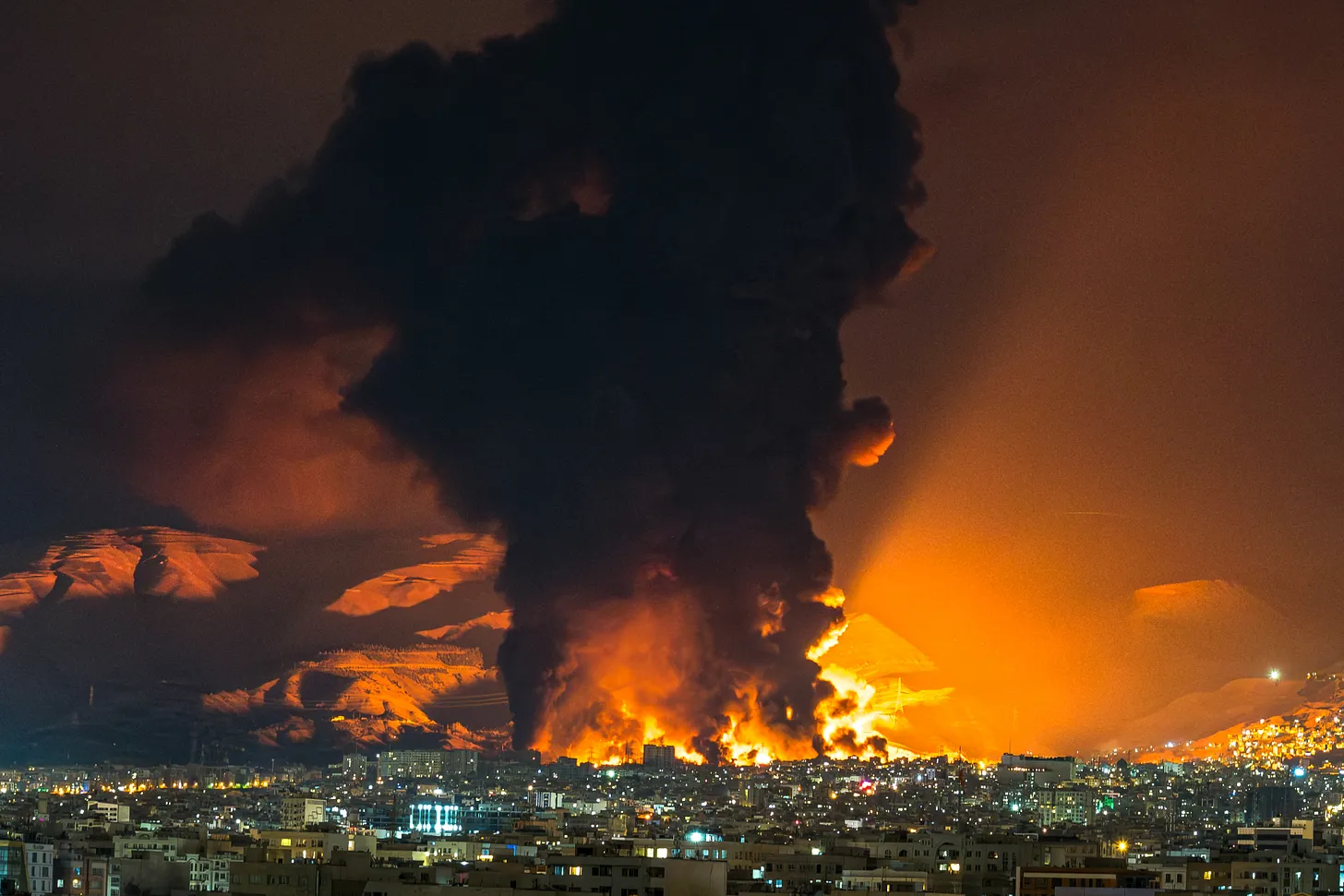
 Saghar recalls the airstrikes that targeted oil facilities in and around Tehran on Saturday with a terrifying clarity. It was exactly one week into the U.S.-Israeli war on Iran and the constant roar of fighter jets overhead punctuated by loud explosions that rattled the windows had already become a familiar sound in the capital.
But at around 10:30 p.m. on March 7, three deafening blasts, distinctly larger than the strikes of previous days, shook her home. Saghar, 24, lives with her parents and sister in a residential complex in northeastern Tehran, perilously close to the Aghdasieh oil depot.
“The house shook, it truly shook. Far worse than an earthquake,” Saghar told Drop Site News. (Saghar is a pseudonym; she requested anonymity to speak with Drop Site News given the war.) “I remember the Tehran earthquake of May 2020—this was exponentially worse. The kitchen and living room windows shattered instantly, and the chandelier swung violently like a pendulum. My mother was at the sink washing dinner plates when the blast hit. The shockwave threw her so hard she landed head-first on the floor.”
A colossal orange flash ignited on the horizon. Israeli airstrikes had targeted major oil depots and infrastructure in the Tehran neighborhoods of Shahran, Aghdasieh, and Shahr-e-Ray, as well as in the nearby city of Karaj. The massive reservoirs of combustible fuel triggered apocalyptic-looking fires that raged throughout the night.
 Hours after Iran launched ballistic missiles at Israel on June 7, the Israeli military said it...
 A recent Israeli study has concluded that starvation in Gaza resulted from a premeditated policy, despite...
 Negative views of both Israel and Israeli Prime Minister Benjamin Netanyahu have soared since last year...
 The latest wave of anxiety followed a statement by Israeli Defence Minister Israel Katz, who warned...